A brief history...
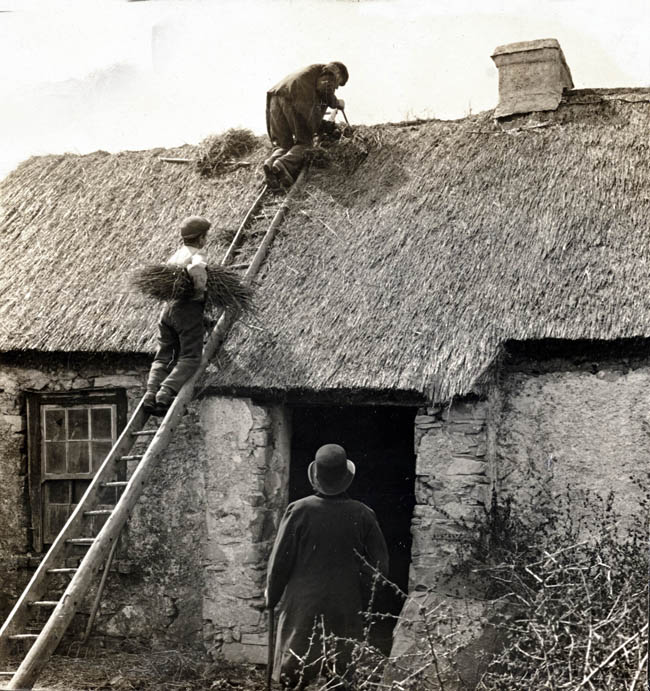
In Ireland, thatched roofs, while once common, are now relatively rare, with just over 2500 left on the entire island. So, while they currently make up a minuscule percentage of the total housing stock in Ireland, in the 1800s, as much as half of the population slept under thatched roofs, so their historical and architectural significance is now more important than ever before.
These thatched cottages were built by the 'ordinary' people, along with their neighbours, using methods passed down within families and communities. These traditions are also part of a shared culture of building in Ireland. Vernacular heritage reflects the creativity and knowledge of our forebears, providing a link with the past that is still worthy of our admiration and respect. Indeed, as we have now come to realize the importance of reducing our 'carbon footprint', we can even look at vernacular buildings as a 'carbon sink'. The greenest buildings are those that already exist! and the lessons to be learned from them are endless. From the sheltered site location, to their south facing position in the landscape, to the use of locally sourced materials to the use of smart insulation measures. They still are the most eco-friendly and sustainable form of housing the country.
The roofs utilize a variety of locally sourced materials like wheat straw, water-reed, marram grass, heather, and bracken, each contributing to distinct regional styles. The techniques for thatching also vary, with some styles involving netting and stone weights to withstand strong winds, while others feature direct fixing to the roof structure.
As durable as they are environmentally friendly, Irish thatched cottages are the products of centuries of history and tradition in Ireland. Their contribution to landscape character, built heritage, culture, tourism and the economy is beyond measure.

Despite a reputation for being draughty and inefficient, old lime rendered, thatched cottages were extremely efficient and designed to work with their environment, which they can still do today, if properly repaired and maintained. Often said to be the original 'Sustainable' and Eco-Friendly' Home, the characteristics of Irish Thatched Cottages, namely their Thick Lime rendered stone walls, Open hearth at floor level, Small windows and Insulating layers of thatch on the roof, meant that they really conserved energy to keep in heat, and Parlour behind fireplace. They were also usually built south facing and in the perfect location to protect them from the elements.
SUSTAINABILITY
Locally grown thatch is a sustainable material, which has little impact on the environment throughout its life-cycle. It requires no chemicals to grow, can be harvested by hand or using traditional farm machinery, requires no mechanical processing and therefore has low embodied energy and can be fixed using hand tools. At the end of its life it can be composted and returned to the land.
Thatch has a much greater insulating value than any other traditional roof covering. With the right choice of material and detailing, a well-maintained thatched roof will keep a building warm in winter and cool in summer and has the added advantage of being highly sound-proof.
PROTECTION, CONSERVATION, REGENERATION
By retaining and appropriately adapting historic buildings, they can be a key part of the solution for lower carbon emissions. Also in terms of Value, there is no doubt that locally, nationally and indeed globally, Irish thatched buildings are environmentally, socially and economically sustainable with an every growing benefit to the economy, to Tourism and of course to built Heritage, Culture and Sense of Place.
The Quiet Man... Thatched cottages are a significant draw for tourists due to their unique charm and historical value, particularly in rural areas. They represent a picturesque and nostalgic image of the past, offering a unique experience for visitors seeking a taste of traditional life and culture.